
What Is Creosote Buildup? A Tennessee Homeowner’s Guide to the Chemistry Inside Your Flue
Creosote buildup is the gradual accumulation of condensed smoke particles—tar, hydrocarbons, and unburned carbon—on the inner walls of your chimney flue. It forms when hot smoke (300–600°F) meets a significantly colder flue surface, causing vaporized compounds to condense and solidify in layers that become progressively harder and more combustible. In Tennessee, where overnight temperatures can drop into the 30s while daytime highs still reach the 60s during shoulder season, this temperature differential creates ideal conditions for rapid creosote formation, especially in homes with older masonry chimneys common in neighborhoods like Germantown and East Memphis. If you’re noticing reduced draft, a strong smoky odor, or black, flaky material around your damper, creosote is likely the culprit — and it’s not something that improves with time. Call Landmark Chimney Cleaning Service Tennessee at (833) 753-1759 for an inspection before your next fire.

Why Creosote Forms: The Condensation Mechanism Most Explanations Skip
Most creosote explainers stop at “flammable residue from incomplete combustion.” That’s true as far as it goes, but it doesn’t explain why the same fireplace, burning the same seasoned oak, produces dramatically different creosote rates from one week to the next. The missing piece is condensation physics — and it’s the key to actually changing your burning habits.
Smoke is a vapor. Like any vapor, it condenses when it hits a cold surface. Your flue is that cold surface. Here’s what that looks like in real numbers:
- Wood smoke exits an active fire at roughly 300–600°F depending on burn intensity and wood species
- A flue wall on a 35°F Tennessee night — especially in uninsulated masonry chimneys common in pre-1980s homes — can register 50°F or lower near the top where it’s most exposed
- That 250–550°F temperature differential causes hydrocarbon vapors to condense on tile or liner surfaces, the same way a cold glass sweats on a humid Memphis afternoon
- The colder the flue and the slower the smoke rises, the more condensation occurs per fire
Richard Anderson, Owner & Lead Technician at Landmark Chimney Cleaning Service Tennessee, puts it plainly: “We’ve pulled out flues in Cordova where the homeowner burned nothing but properly seasoned hickory, but they ran small, low fires all winter because they were trying to ‘stretch’ their wood. The flue was cold, the smoke lingered, and they had Stage 2 creosote three inches thick. Wood quality matters, but flue temperature matters more.”
This is why the “shoulder-season smolder” is so problematic in Tennessee’s climate. October evenings in the 40s and 50s tempt homeowners to light “just a small fire” — but the flue hasn’t had time to warm up from summer dormancy, and the low heat output produces the most condensation-prone smoke conditions possible. The flue is cold, the fire is small, the smoke barely moves. That’s a creosote accelerator hiding in plain sight.
The Three Stages of Creosote: What You’re Actually Looking At
Not all creosote is the same, and the stage determines both fire risk and removal difficulty. Richard describes the progression with a practical analogy he uses on jobs:
Stage 1 — Dry, Flaky, Brushable
Think of this like ash that stuck to the walls. It’s mostly soot with some lighter tar content, dark gray to black, and brushes off with standard chimney sweep brushes. This is what a properly maintained flue accumulates over a season of normal use. In our Chimney Cleaning & Sweep work, this is the ideal — it means you’re burning hot enough and sweeping often enough.
Stage 2 — Sticky, Tar-Like, Spongy
Now we’re into thick paint that’s started to cure. It’s dark brown to black, gummy, and requires more aggressive tools — rotary whips, chains, or chemical treatments to break down before mechanical removal. Stage 2 indicates either repeated low-temperature burning or a flue that stays chronically cold. This is where we start seeing accelerated deterioration of clay flue tiles through thermal cycling.
Stage 3 — Glazed, Shiny, Hardened
This is closer to lacquer or hardened resin — glossy, dense, and extremely difficult to remove. Stage 3 creosote forms when Stage 2 material is repeatedly heated and cooled, essentially baking it into a ceramic-like coating. It burns at temperatures exceeding 2,000°F, far beyond what standard chimney construction is designed to contain. Removal requires specialized equipment and often takes multiple passes. In severe cases, we’ve seen Stage 3 buildup reduce flue diameter by 25% or more, choking draft and creating a genuine chimney fire hazard.
Here’s how the stages compare for Tennessee homeowners:
| Stage | Appearance | Removal Difficulty | Fire Risk | Typical Cost Range in Tennessee |
|---|---|---|---|---|
| Stage 1 | Dry, flaky, soot-like | Standard sweep | Low | $180–$250 |
| Stage 2 | Sticky, tar-like, spongy | Mechanical + chemical | Moderate | $280–$450 |
| Stage 3 | Glazed, shiny, hardened | Specialized removal, often multiple sessions | High | $450–$750+ |
When Stage 2 or 3 creosote has been present for multiple seasons, it accelerates deterioration of clay flue tiles through thermal shock — the repeated expansion and contraction from heating cycles weakens the masonry. Professional-grade products like HeatShield exist specifically to restore flue liner integrity after this kind of damage, without requiring full liner replacement in every case. We evaluate each flue individually and recommend HeatShield or a DuraFlex stainless liner based on what we find, not on a predetermined upsell script.
Tennessee-Specific Factors That Accelerate Creosote Buildup
Tennessee’s climate and housing stock create conditions that speed creosote formation compared to drier, more consistently cold regions. Here’s what we see in the field:
The Shoulder-Season Smolder
Memphis and Shelby County see 40–60 degree temperature swings common in October and November. Homeowners light “small warming fires” before the heating season fully arrives. The flue is still cold from summer dormancy, often 55–65°F internally. A small fire produces low-velocity smoke that lingers in the flue, maximizing condensation time. We’ve documented cases in Midtown Memphis where a single season of shoulder-season burning produced Stage 2 creosote that normally takes three winters of proper cold-weather burning to accumulate.
Humidity and Wood Storage
Eastern Tennessee’s higher humidity, especially in river-adjacent neighborhoods, means even “seasoned” wood often carries 25–30% moisture content rather than the ideal sub-20%. But here’s what most miss: the moisture itself isn’t the primary creosote driver. It’s that wetter wood burns cooler, producing more smoke volume at lower temperature, which then hits that cold flue wall. The combination is what matters.
Older Masonry and Unlined Flues
Pre-1960s homes in neighborhoods like Central Gardens, Annesdale-Snowden, and parts of Cooper-Young often have original clay-tile flues with no liner, or liners that have cracked from decades of thermal cycling. Unlined or damaged liners lose heat faster, keeping flue walls colder and increasing condensation. Richard notes: “In Germantown, we’ve got homes with 1920s chimneys that were built for coal — the flue dimensions are wrong for modern fireplaces, the draw is poor, and the creosote accumulates in patterns that baffle homeowners who think they’re doing everything right.”
The “Slow Burn” Misconception
Many Tennessee homeowners intentionally restrict air supply to “make the wood last longer.” This is counterproductive for creosote control. A restricted-air fire smolders at 200–300°F lower combustion temperature, producing vastly more incomplete combustion products. The smoke is cooler, denser, and richer in condensable compounds. Per cord of wood, a restricted “slow burn” can produce 3–5 times the creosote of a hot, well-oxygenated fire, regardless of wood moisture content.
Prevention That Actually Works: Beyond “Burn Dry Wood”
The standard advice — burn dry wood, get annual inspections — is correct but incomplete. Here’s what changes creosote formation rates in measurable ways:
Build Fires That Sustain High Combustion Temperature
This means adequate air supply (damper fully open during ignition and active burning), sufficient fuel mass to maintain a hot core, and avoiding the temptation to “damp down” the fire for extended burns. A hot, fast-burning fire produces less smoke per BTU, and the smoke that does form stays hotter longer, reducing condensation in the flue.
Preheat the Flue Before Full Fires
Especially in shoulder season or after the chimney has been idle, a small kindling fire near the flue opening — or even a rolled newspaper torch held up the damper — warms the flue column and establishes draft before the main fire is built. This simple step, which takes under two minutes, can reduce first-fire condensation by half.
Maintain Continuous Fires During Cold Spells
Once a flue is warm, keeping it warm reduces creosote. If you’re burning daily during a cold snap, the flue never fully cools between fires. The same total wood burned across intermittent cold days produces more creosote than the same wood burned across consecutive days.
Address Liner and Masonry Condition
Damaged liners and deteriorating masonry accelerate heat loss. Products like HeatShield can restore smooth, insulated flue surfaces that maintain higher internal temperatures. In cases of severe clay-tile deterioration, a stainless steel liner from Olympia Chimney or a DuraFlex system provides a complete solution that also improves draft performance.
A clean flue is a quiet flue — you shouldn’t have to think about it until next season. When creosote is managed properly, your fireplace performs predictably and safely. When it’s ignored, the problems compound in ways that become expensive fast.
When Creosote Becomes a Safety Issue: Warning Signs
Some indicators mean the situation has moved beyond routine maintenance:
- Visible tar-like drips in the firebox or around the damper — indicates Stage 2 or 3 buildup that has become thick enough to liquefy during hot fires
- Strong, acrid odors during humid weather — creosote is hygroscopic and releases volatile compounds when it absorbs moisture
- Reduced draft or smoke spillage into the room — buildup may be physically obstructing the flue
- Cracking or spalling sounds from the chimney during a fire — potential chimney fire in progress; evacuate and call emergency services
- Discolored or distorted chimney cap — indicates previous overheating events, often from small chimney fires the homeowner didn’t notice
Chimney fires from creosote ignition don’t always announce themselves dramatically. Many start and extinguish without the homeowner ever knowing, causing cumulative damage to liners and surrounding structure. By the time obvious signs appear, the underlying damage may require significant repair.
What Professional Creosote Removal Involves
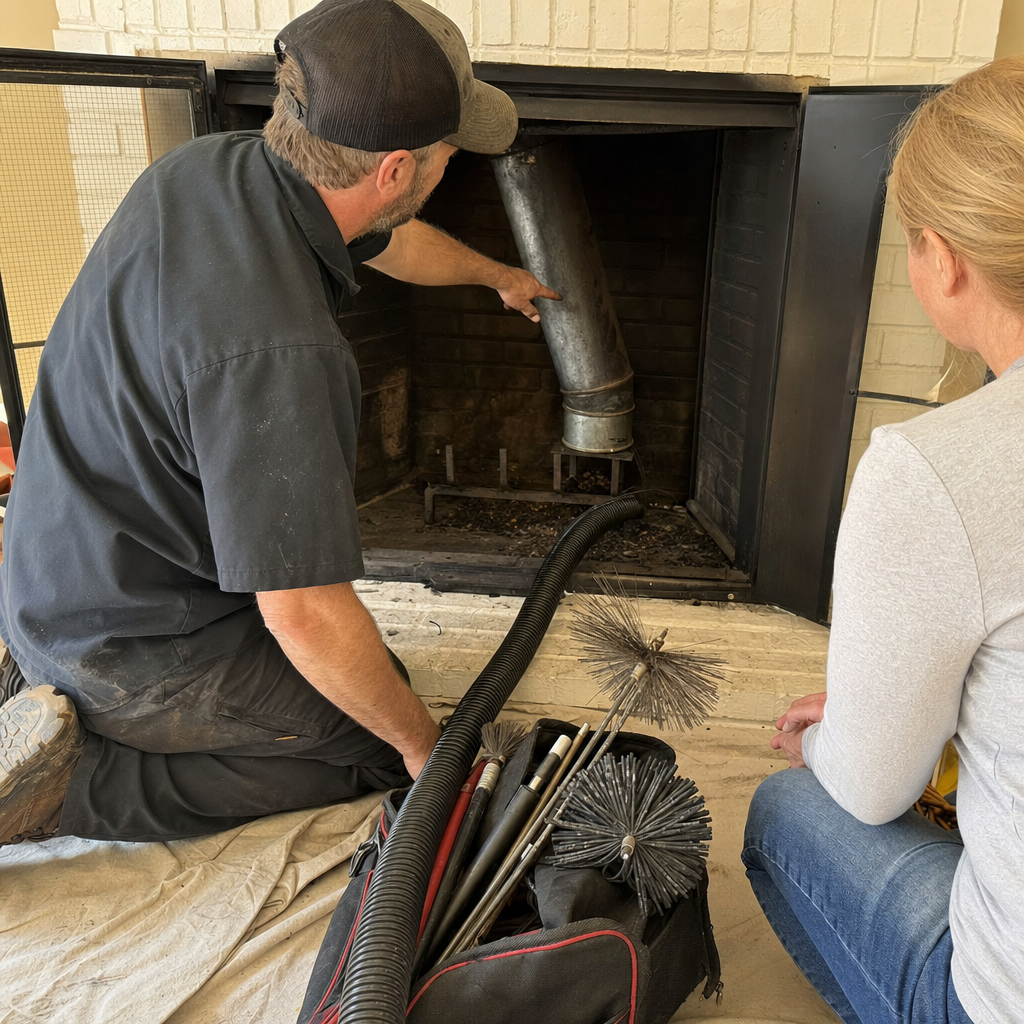
For Stage 1 buildup, our standard Chimney Cleaning & Sweep service uses professional-grade brushes, vacuums with HEPA filtration, and rotary tools where needed. We contain the work area, inspect the flue with a camera afterward, and provide documentation of what we found and removed.
Stage 2 and 3 buildup requires additional steps:
- Chemical treatment to soften glazed deposits, sometimes applied days before mechanical removal
- Rotary chain systems or specialized whips that can fracture hardened material without damaging underlying flue tiles
- Multiple cleaning passes with intermediate camera inspection to verify complete removal
- Assessment of liner condition and recommendation for HeatShield restoration or DuraFlex liner installation if damage is present
We use the same materials the pros spec — Gelco and Famco for caps and crowns, Olympia Chimney and Copperfield for venting components, HeatShield and DuraFlex for liner restoration and replacement. These aren’t consumer-grade products; they’re what certified chimney professionals specify nationwide because they hold up to real conditions.
Every job is guided by Richard personally — 14 years, one specialty, and the same technician who built Landmark’s reputation. From your annual sweep to a full liner rebuild, one company handles it. No coordinating separate contractors, no wondering who’s actually showing up at your door.
FAQs
Standard Stage 1 creosote removal through chimney sweeping typically runs $180–$250 in the Memphis and Shelby County area, while Stage 2 or 3 buildup requiring specialized removal ranges from $280–$750 depending on severity and accessibility. Factors that increase cost include multiple flues, steep roof pitch requiring specialized access equipment, and the need for chemical pre-treatment or multiple sessions. Call (833) 753-1759 for an exact quote — estimates are free, and we’ll tell you honestly whether your situation requires basic sweeping or more involved work.
The National Fire Protection Association recommends annual inspection for all wood-burning systems, regardless of apparent performance. In practice, Tennessee homeowners who burn 2–3 times weekly during heating season should plan on annual sweeping; those with occasional weekend use may extend to every two years if the previous inspection showed minimal Stage 1 accumulation. However, if you notice any warning signs — odors, reduced draft, visible buildup — schedule immediately regardless of timing. We inspect with camera equipment so you see exactly what we see, not just take our word for it.
Stage 1 surface soot can sometimes be reduced with proper fireplace tools and a chimney brush of correct diameter, but we don’t recommend DIY removal for several reasons: most homeowners can’t safely access the full flue length, can’t verify complete removal without camera inspection, and routinely underestimate Stage 2/3 buildup that requires professional equipment. More critically, the inspection that accompanies professional sweeping often reveals hidden issues — cracked liners, deteriorating mortar, blocked caps — that DIY cleaning misses entirely. Given that chimney fires cause over 25,000 house fires annually nationwide, the modest cost of professional service is poor economy to skip. Call (833) 753-1759 and we’ll assess what you’re actually dealing with.
Hardwoods like oak, hickory, and maple produce less creosote per BTU than softwoods like pine, primarily because they’re denser and burn hotter when properly seasoned. However, wood type is a secondary factor to burn temperature and flue condition. We’ve seen chimneys with severe Stage 3 creosote where the homeowner burned nothing but seasoned oak — but burned it cold, in a restricted-air fire, in an unlined flue on a 40-degree night. Conversely, we’ve seen clean flues where pine was the primary fuel but burned hot with good air supply in a well-maintained, insulated liner. The wood matters, but how you burn it and what you’re burning it in matter more. For specific guidance on your setup, Richard can evaluate during an inspection — call (833) 753-1759 to schedule.
Regular maintenance is dramatically less expensive. Annual sweeping at $180–$250 prevents the progression to Stage 2 or 3, where costs multiply and hidden damage accumulates. A single chimney fire — even one you don’t know happened — can crack flue tiles, damage mortar joints, and compromise the chimney structure, turning a $200 maintenance item into a $2,000–$5,000 repair or liner replacement. We use HeatShield and DuraFlex systems when damage has occurred, but we’d rather help you avoid needing them. 364 homeowners have rated us 4.9 stars because we give honest assessments, not scare tactics — if your flue only needs cleaning, that’s all we’ll tell you.
If you’d rather have it looked at, Landmark Chimney Cleaning Service Tennessee offers a no-pressure assessment in Tennessee — call (833) 753-1759.
Written by Richard Anderson, Owner & Lead Technician at Landmark Chimney Cleaning Service Tennessee, serving Tennessee, TN.